
When businesses think about security, the focus usually goes straight to what’s happening inside the building: intruder alarms, access control, CCTV in reception or the warehouse. These are all important. But there’s a problem with that approach. If your perimeter isn’t properly secured, intruders may never need to get past those internal systems at all.
In many cases, unauthorised access doesn’t involve forced entry. It involves walking through an unmanned gate, slipping past an unlit entrance, or accessing a car park with no barrier or camera coverage. The threat starts outside, which means your protection should too.
What Is Perimeter Security?
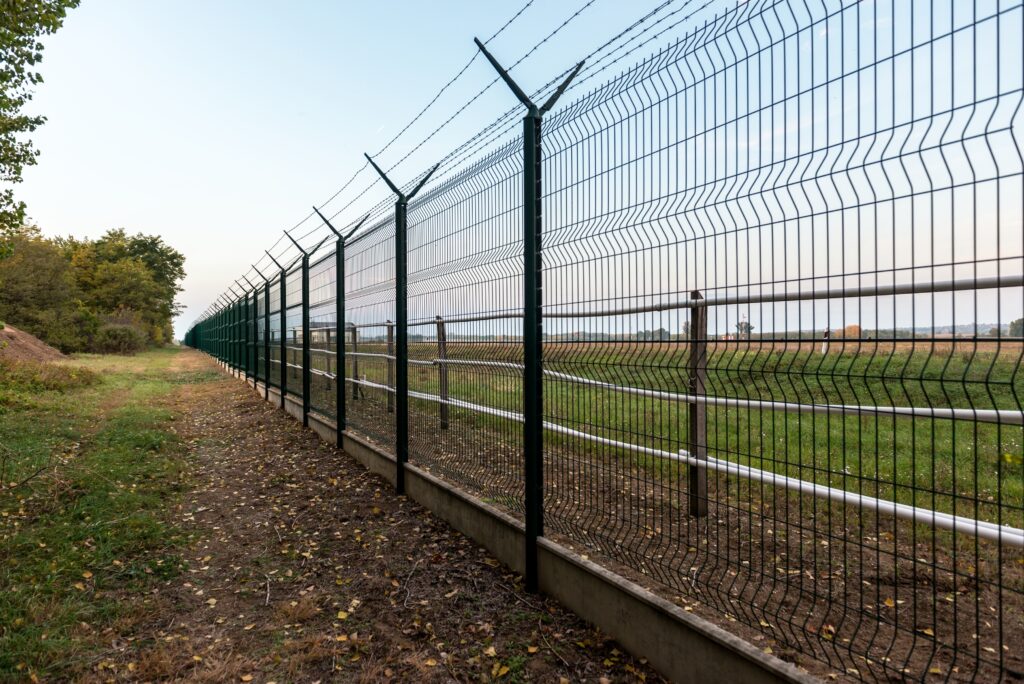
Perimeter security is the practice of protecting the outer boundary of your site before a threat reaches your building. Rather than reacting once someone is already on-site, a well-designed perimeter puts deterrents and controls in place at the earliest possible point.
For commercial sites, this typically includes a combination of:
- Security fencing and anti-climb measures – physical barriers that make unauthorised access significantly harder
- Gates and automated access control – controlling who enters, when, and with what authorisation
- CCTV coverage of external areas – monitoring boundaries, car parks, delivery areas, and entry points
- External lighting – removing the cover of darkness and making activity visible
- Barriers and bollards – protecting against vehicle-based threats or ram-raiding
No single element works in isolation. The most effective perimeter security combines these layers so that if one measure is tested, others are already in place.
Why Internal Security Alone Isn’t Enough
A strong internal security setup gives you confidence about what’s happening inside your building. But it doesn’t stop someone from entering your site uninvited, accessing vehicles or equipment stored outside, or causing damage before they ever reach a door.
For businesses with outdoor assets such as plant machinery, fleet vehicles, materials, or stock, the perimeter is often where the real risk sits. The same applies to multi-occupancy sites, industrial estates, and premises with high footfall or public access.
Without proper perimeter protection, you’re effectively relying on internal systems to catch a problem that could have been prevented much earlier.
The Business Case for Securing Your Perimeter
Beyond the obvious security benefits, a well-secured perimeter makes practical business sense.
Deterrence is cost-effective. Visible security measures including fencing, lighting, cameras, and controlled access points reduce the likelihood of an incident occurring in the first place. Prevention is almost always cheaper than dealing with theft, damage, or the disruption that follows.
It supports compliance and due diligence. Many businesses have insurance requirements, site accreditations, or contractual obligations that include perimeter security provisions. Getting this right from the outset avoids issues down the line.
It signals professionalism. For clients, contractors, and visitors arriving at your site, a well-secured perimeter reflects positively on your business. It shows that security is taken seriously.
It integrates with your wider security setup. A perimeter system doesn’t sit in isolation. External CCTV can feed into your internal monitoring, access control at your gate can tie into your building access system, and lighting can be linked to detection triggers. When designed properly, everything works together.
Getting the Design Right
Every site is different. A retail park, a construction yard, a school campus, and a logistics hub all have different layouts, risk profiles, and access requirements. That’s why perimeter security needs to be assessed and designed around your specific site, not applied as a one-size-fits-all solution.
The key considerations are:
- Where are the vulnerable entry points?
- What assets need protecting, and where are they located?
- How much access does the site need to support day-to-day operations?
- What level of deterrence versus monitored response is appropriate?
A site survey is usually the starting point, allowing a security professional to assess the boundary, identify weak points, and recommend a solution that’s proportionate and practical. You can see examples of this approach in our Hertfordshire gates case study and Bloxham School project.
Speak to Oakpark
At Oakpark, we design, supply, and install perimeter security solutions for commercial and industrial clients across the South East and Midlands. Whether you need automated gates, CCTV coverage, access control, or a fully integrated solution, we’ll design something around your site and your requirements.
Get in touch to arrange a site survey or request a free quote.